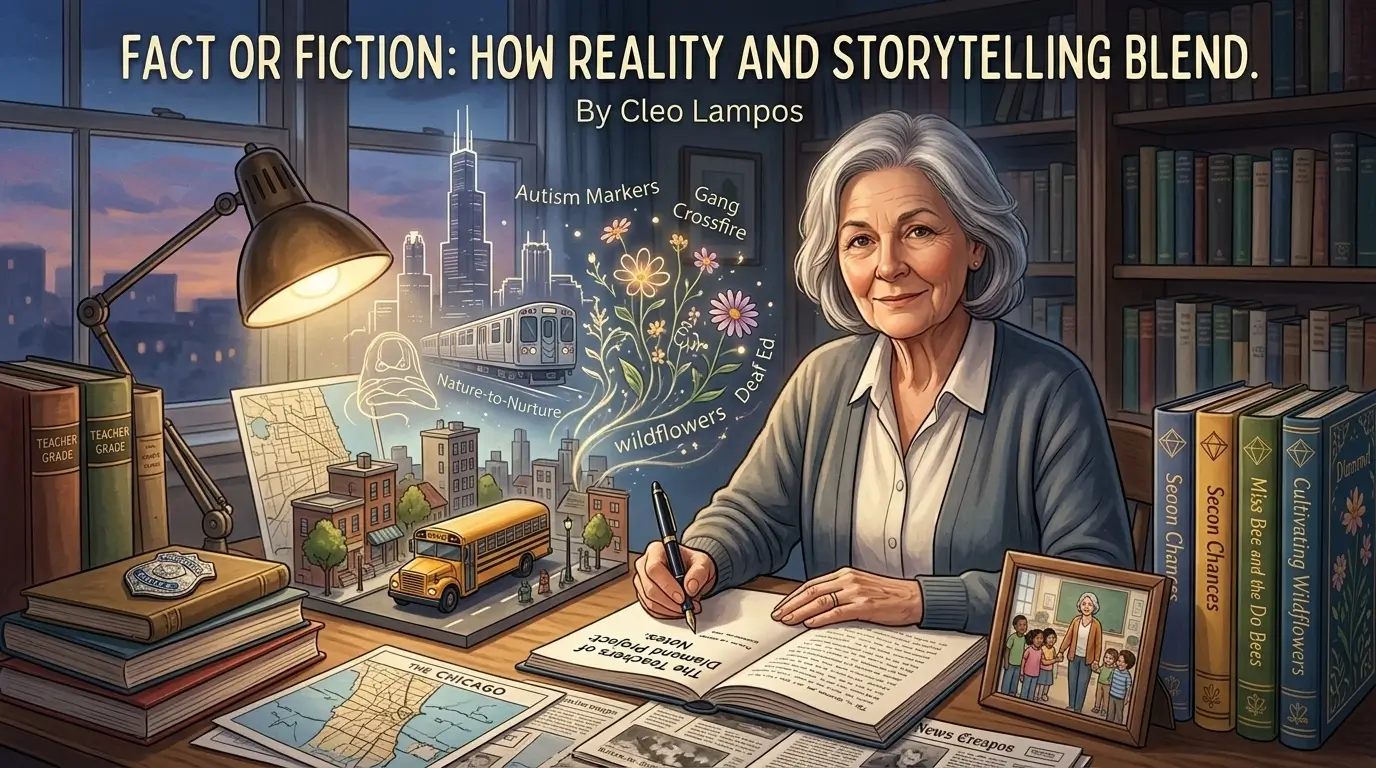
Mark Twain is credited with this piece of advice to author wannabees. “Write what you know”. What did I know at the turn of the millennium? After decades of teaching, the role of an educator to various categories of students was my field of knowledge. The question became: “How do I write about my experiences in a genuine way without creating an autobiography? How does reality and storytelling blend?”
My imagination works best at the three-in-the-morning wake up. Quiet darkness allows my mind to mull over possibilities in writing. Some of my best lectures were rehearsed in my dreams when the subconscious takes over. Through a combination of these strategies, the Teachers of Diamond Project Schools: Diamonds in the Tough was born. The premise involved bringing the reader into the classrooms of three distinct special education classrooms in an imaginary school district within Chicago Public Schools.
My experiences in these settings provided the realistic facts needed to create believable characters. The fiction part developed from newspaper clippings, stories from veteran teachers told across lunchroom tables, and narratives told by men in uniforms. This blend of fact and fiction created the realistic series: The Teachers of Diamond Project Schools.
First-Year Teacher
Every teacher’s first year of classroom teaching presents predictable difficulties. Those common challenges provide the conflict in the first book of the series: Secon Chances. However, I was a new teacher in an urban setting who had lived all her life on Midwest farms or one-stoplight towns. So, Zoey Pappas, the fourth-grade teacher in this novel had taken the challenge to teach in Chicago despite her rural childhood. When Zoey takes a short cut to a teacher’s conference and finds herself in neighborhood sporting graffiti and rundown buildings, she doesn’t know what to do. The policeman who stops her leans in the window and remarks, “This isn’t Kansas, Dorothy. Follow me.” That really happened, and thank goodness, the policeman got me back on the main road. Lots of facts in this novel.
The fiction part mirrors the many reminiscent narratives that my Greek husbands’ aunts and uncles recounted about emigrating to America. The family expectation for the daughters was to stay close to home, earn an M.R. S. and work in the parent’s restaurant. Zoey Pappas. The influence of Greek immigration clashes with Zoey’s desire to teach in a drug-infested, crime-ridden school district. Officer Gavin Corrigan is assigned to her school, and sparks fly between the two. Zoey enters the world of deaf and hard of hearing students as well as the challenges that foster parents face. Creatively intertwined with fact, these fictional elements bring the country girl gaining mastery of the city into a believable and satisfying read.
Special Education Teacher
This novel, Miss Bee and the Do Bees, contains many of the challenges that greeted me as a special education teacher. From the fact that the main character, Roni Bagedonas, wears tee shirts and long, tiered skirts because she has body image challenges, to the unorthodox manner of teaching in the classroom, my personal experiences highlight many of the pages. Yes, the scene when the teacher crawls under the table to talk with a traumatized student is real. So is the fact that the school bus drove into the crossfire of gangs with damage to the bus. Characteristics of the students portrayed within the novel match those of autistic and emotionally disturbed children. A factual representation of an urban special ed class.
The fictional side of the novel is the relationship with Joe Malinkavich, an emergency responder for the fire department and his growing interest in Roni. The introduction of a teacher’s aide, Sunny, who was a beauty queen is fictional but believable. The scene in the hospital where Sunny steps into the ward to visit her fiancé who has been wounded in Afghanistan is a compilation of narratives that my brother, an occupational therapist at a Veteran’s hospital, and magazine articles about how women respond to disabled soldiers. The combination of fact and fiction creates an inspirational focus that will feed the soul as well as the mind.
Summer School Teaching
Cultivating Wildflowers brings the skills of Alana Alcott, an urban teacher of gifted students with the philosophy of Mike Reynolds, an Outward-Bound Instructor. Alana has been court ordered to teach summer school with Reynolds for five unruly foster kids whose stories of abandonment mirror Alana’s own childhood. The facts in this novel are based on the nature-to-nurture philosophy that Alan and Mike agree to utilize. If the reader has a map of Chicago, it would be possible to follow the summer school participants as they visit familiar sites in Chicago that promote ecological principles. The depiction of each child’s diagnosis is based on standard markers. Street art, as opposed to graffiti, is a Chicago signature of artistic expression.
The fiction part of this novel is the plot. Bringing in street art as a component to the action serves to highlight the need for beauty in the concrete landscape of the projects. The depiction of students with behavioral issues to a looming gang recruitment is woven into the plot as reality. The facts of life in Chicago create believable romantic fiction.
Fact or Fiction
Using the facts and weaving them into fiction that is believable is the master craft of authors.
Anyone who has enjoyed Stand and Deliver, A Tree Grows in Brooklyn, My Posse Don’t Do Homework, or Tisha will appreciate the Teachers of Diamond Project Schools series.